Design Infrastructure at Carbon6
Creating the operating layer for design across 16 companies acquired in 16 months.

Context
Carbon6 grew by acquisition, 16 companies in 16 months, and 25+ tools for Amazon sellers. Every acquisition brought a product and whatever files came with it, and none of them brought a design team. The whole design function was me and two other UX designers.
What arrived was rarely usable. Roughly half the portfolio came in with nothing worth keeping, so no current Figma files, no design system, no source of truth. The artifacts that let a company reason about its own products (sitemaps, user journeys, flows) did not exist for most of it, and there was no design philosophy for the brand overall.
All of that landed on the three of us. In practice the top six tools took about eighty percent of the attention and the bottom ten got almost none, but when anything was needed, from any product in the suite, it came to design.
The cost of that showed up in rooms rather than in tickets. As the company matured and moved toward a sale, people started asking what exists and why is it built this way, and nobody could answer, because there was nothing to point at.
My Role
Lead designer across the portfolio, from 2022 through the SPS Commerce acquisition and beyond. I directed two UX designers alongside my own IC product design work, and I absorbed each acquired product as it came in.
This one was my initiative start to finish, nobody assigned it to me. I saw what was missing, made the case for it, designed the approach, and then executed it across product, engineering and the individual acquisition teams.
Discovery & Research
I mapped the gap between what existed in the design files, what existed in documentation, and what teams actually did day to day, across the full portfolio.
The pattern was consistent even though the specifics were not. Every product was fragmented in its own way and every one had a different reason for it: this one's designer had left, that one had never had a designer at all, another had documentation that no longer matched the build. Onboarding and handoff broke differently on each of them.
That mapping is what let me argue the problem was structural rather than 25 separate messes.
What I Built
The operating layer, meaning the things that crossed products rather than living inside any one of them:
A single source of truth. Every product got a Figma space under one umbrella organization, holding three to ten files built to shared guidelines, paired with a Confluence folder with sub-pages per feature and per release. Design decisions, product context and implementation guidance sat together instead of in three places nobody could reconcile. It grows with every feature designed and shipped.
A design philosophy for the brand overall. The first articulation of what Carbon6 products should feel like as a set, rather than as 25 separately acquired opinions.
Design system work. Unified treatment in Figma across all tools, mirrored in Confluence, with the underlying systems rebuilt rather than patched. Product and engineering accepted it as the source of truth for design information.
The missing design assets. Sitemaps, user journeys and flows, at least one for 10+ products, the full set for the top tools, and the rest built as problems surfaced. Most of these had never existed.
Standards and reusable assets so each new acquisition could be absorbed against a template instead of from scratch.
What Was Hard
Getting the system agreed was not the hard part. I spent real time on how to propose it, and once it was in front of people it landed, because the gaps were obvious enough that anyone who had been asked an unanswerable question already agreed with me.
The hard part was per product, and it came back every single time. Not every tool in a 25 product suite deserves the same design investment. Some were strategic, some were in maintenance, some had been bought for a customer list, and a few were somewhere in between. Each acquisition reopened the same conversation about how much effort goes into building the missing assets and improving this interface, given what the thing is actually worth to the business. There was no formula and no mandate that settled it, so I had to make the call each time and then defend it.
What Happened
Absorbing a newly acquired product went from months to weeks. New products now came in against a template instead of a blank file.
Onboarding a new designer stopped depending on me being in the room. Product context was readable rather than transferred in conversation.
Product and engineering adopted the Confluence and Figma layer as the source of truth for design information. People outside design were using the documentation, which was the test it had to pass.
The documentation answered questions during diligence. The artifacts that explained what existed and why it was built that way were there when somebody finally asked for them.
Carbon6 was acquired by SPS Commerce for $210M USD, announced January 2025 and closed February 2025. I built this during the period the company was maturing toward that sale.

Components in Style Guide
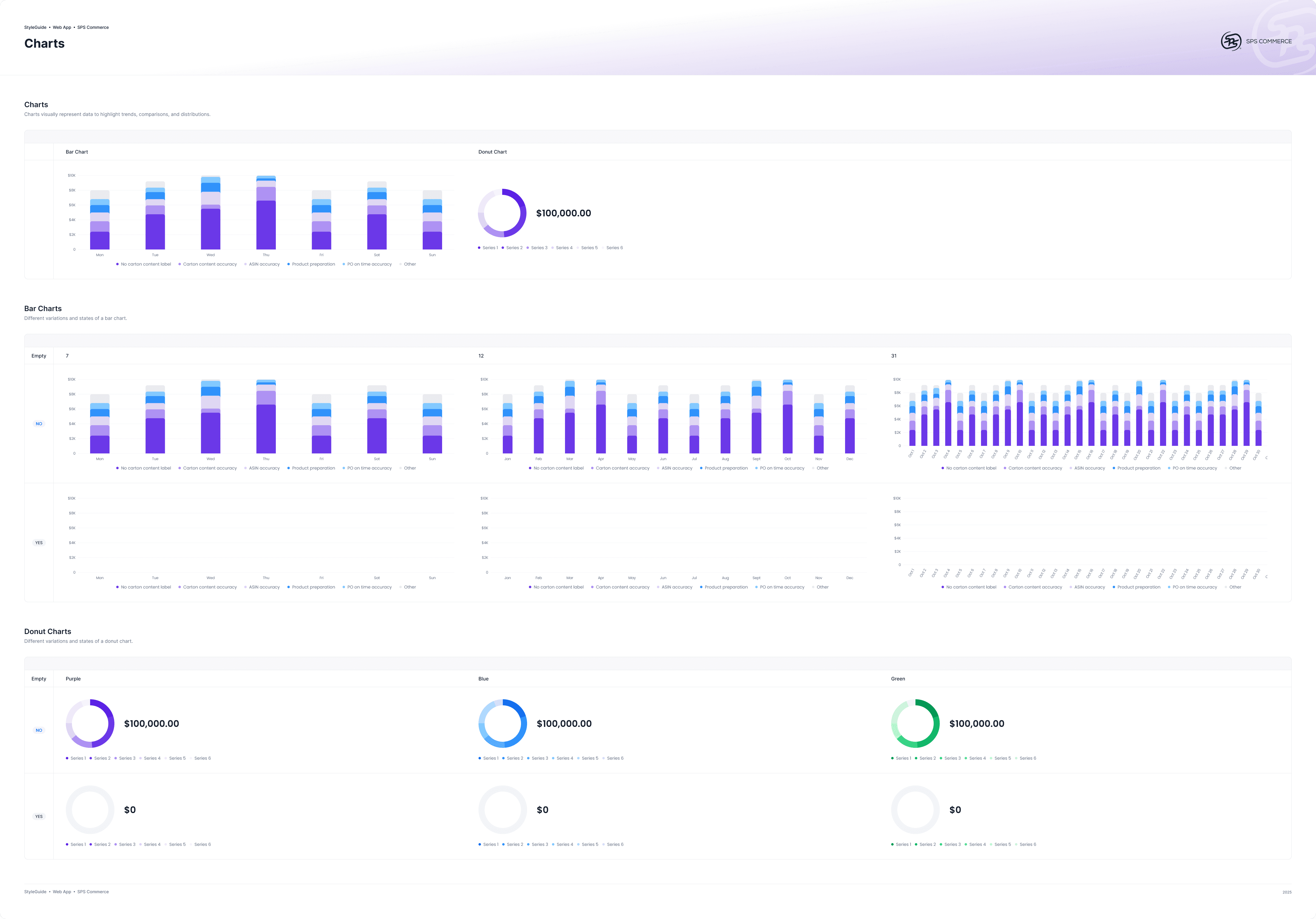
Reusable patterns / Faster delivery
Figma Feature

Clear workflows / Scalable design